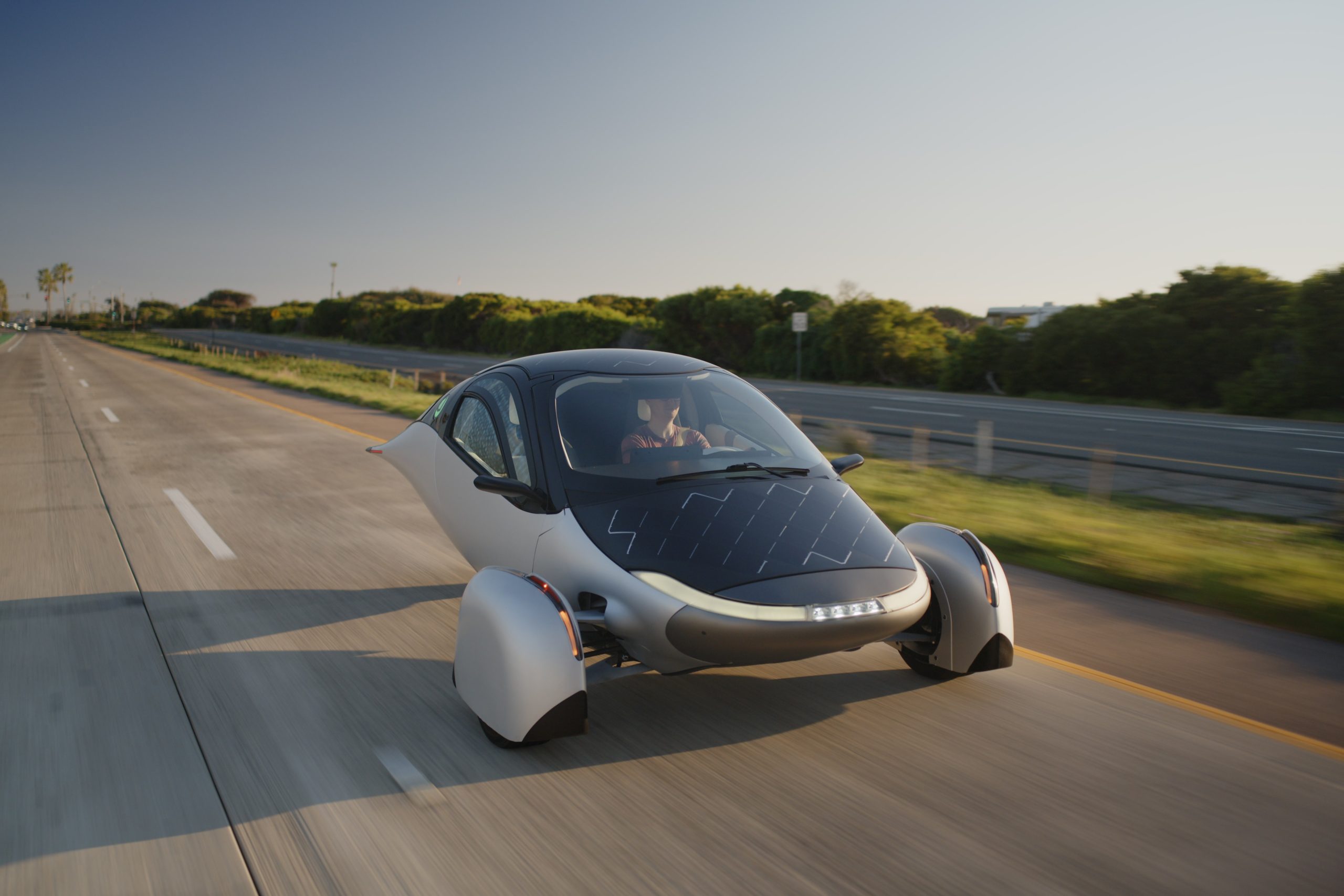
Over the past several weeks, we’ve been tracking daily solar generation on our validation vehicles (codename Atlas), and today we’re pulling back the curtain to show you exactly what that looks like. The charts below show actual data logged directly from the vehicle’s onboard solar charge controller. All data was logged outside our Carlsbad headquarters as seen in the photo above.
The Data

On this day, Atlas spent a full solar day capturing data from 5:37 AM all the way to 7:02 PM. The day came with a real-world twist: heavy cloud cover through the morning hours kept early generation modest. The vehicle started the day facing west, and the rear hatch was oriented east to catch the morning sun.
Thanks to the large curvature of Aptera’s solar panels, parking with the front facing east or west (rather than north or south) is the best way to maximize energy capture throughout the day. At solar noon, the vehicle was rotated so the front faced east, swinging the hatch to face west for the afternoon. That strategy paid off: generation climbed steadily as the clouds cleared, peaking at 584 watts at 1:42 PM, before tapering off as the evening light faded.
By end of day, Atlas had generated 4.4 kWh of energy, equivalent to approximately 44 miles of added range based on Atlas’s target efficiency of 100 Wh per mile. This shows what’s possible with just one repositioning.

During this day of solar testing, the vehicle was parked in a fixed position while we tracked the sun throughout the day. The result is a clean bell curve, exactly what a great solar day looks like.
Generation kicked off at 6:51 AM, climbed steadily through the morning despite some broken cloud cover early on, and peaked at 527 watts just before 1 PM. The afternoon brought a smooth, symmetrical decline, with a brief patch of clouds returning near sunset before the day wrapped up at 7:10 PM. By end of day, Atlas had captured 12.3 hours of sunlight and generated 3.9 kWh. Based on our target efficiency of 100 Wh per mile, that is roughly 39 miles of added range. This day is a great example of what Atlas can do just sitting still in a sunny parking lot.

This day experienced more clouds than usual, with overcast skies through the morning until nearly 10 AM and again in the evening starting around 4:42 PM, creating that choppy, jagged drop-off you can see on the right side of the chart.
In between, Atlas powered through a clean midday stretch to peak at 519 watts at 1:24 PM. Despite all of that, the vehicle still generated 4.0 kWh over 12.1 hours of sunlight captured, parked in a fixed position the entire day. Based on our design target, that is a 40-mile day with clouds bookending it. The solar panels on Atlas do not need a perfect sky to do their job.

This day was arguably the cloudiest of the bunch. Generation got off to a strong start in the morning, then took a sharp dip as clouds moved in around 9:30 AM and stuck around through nearly 1 PM. Even with that extended overcast stretch covering the prime midday hours, the vehicle still managed to peak at 499 watts at 10:55 AM and finished the day at 3.6 kWh over 10.1 hours of sunlight captured.
The team repositioned the vehicle throughout the day to keep it optimally aligned with the sun as conditions shifted. At 3.6 kWh, this is the lowest total in our data set, but even on one of the cloudiest days we tested, Atlas still generated roughly 36 miles of added range based on the target efficiency of 100 Wh per mile.

This day produced the highest energy total in this dataset, at 4.6 kWh, or roughly 46 miles of added range based on our target efficiency of 100 Wh per mile. The chart has a distinctive flat-topped shape through the midday hours, which reflects what active repositioning can do.
By keeping the vehicle optimally aligned with the sun throughout the day, generation stayed consistently high for an extended stretch rather than tapering off on either side of a single peak.
Morning clouds cleared quickly by around 9 AM, and Atlas powered through a strong midday run, peaking at 569 watts just after noon. Evening clouds moved in earlier than usual around 3:39 PM, creating the choppy decline visible on the right side of the chart. At 4.6 kWh, this is a great example of what an Aptera is capable of with the right positioning. Just imagine what a completely clear day would look like.
Why We Test with Repositioning
Repositioning the vehicle throughout the day might sound like extra effort, but it’s actually pretty natural when you think about how most people use their vehicles. It’s easy to imagine moving your Aptera two to four times a day just going about your routine: driving to work, heading out for lunch, running errands, and coming home.
Parking with sun exposure in mind is a simple habit, and repositioning once around solar noon, when the sun is at its peak, is something most people can do coming back from a lunch break. The goal is not to ask Aptera owners to go out of their way. It is simply to show that a little awareness of where you park can meaningfully add to your daily solar range.
What the Data Tells Us
This data shows us something genuinely exciting: Aptera generates meaningful solar energy consistently, across a range of real-world conditions.
From a clean bell curve day to mornings and evenings battling cloud cover, the results held steady between 3.6 and 4.6 kWh, translating to roughly 36 to 46 miles of added range per day just from the sun based on the design target of 100 Wh per mile. No plugging in. No detour to a charging station. Just sunlight doing its job.
We will continue sharing data as testing progresses, and we cannot wait to show you what comes next.